DNA testing is becoming the go to place for solving family history mysteries such as identifying an unknown parent’s family. If you are thinking about taking a DNA test where do you start?
Which Testing Company?
There are five main DNA testing companies for genealogical testing. These are different to forensic DNA testing to solve crimes and most of these genealogy databases do not allow law enforcement to use of their database without a warrant.
Some of the things to consider before taking a test include: the size of the database, if you need to do more than one test to be covered by several databases, how easy it is to use the database and your chances of gaining anything from it.
In August 2023 the International Society of Genetic Genealogy (ISOGG) published an “Autosomal DNA testing comparison chart”. https://isogg.org/wiki/Autosomal_DNA_testing_comparison_chart
This chart confirmed the largest database with over 23 million users was AncestryDNA and the smallest was the UK based LivingDNA with only 300,000 users. All five databases differed as to the responsiveness of its users and their knowledge of their own ancestry.
Ancestry:
From my own experience, although Ancestry has the largest DNA database its response rate from other DNA testers is not as high as you would expect.
In the past 12 months I have contacted 67 Ancestry DNA matches of which 45 had seen the initial message but only 34 had replied (Ancestry has a tick system so you can see who has viewed your message). Of those who replied only 11 knew anything about their family tree or on which family line they may connect. The other 23 did not even say if the predicated DNA match was on their maternal or paternal side (something Ancestry shows next to every DNA match listed).
On each users profile page there is an indication as to when that person last accessed their Ancestry account. I only contacted those who had been active in the past few months.
Some of the issues with the response rate could be linked to Ancestry’s communication system. Members are supposed to receive email messages when they have been sent a message, however I know from testing that this does not always happen. (Ancestry blames this on the email account being used but in my own experience I can receive messages from some people and not others).
One of the responses I received was replied to after 16 months as he had not seen the notification that he had received a message, even though he was active on the site on a fairly regular basis. I have also receive a reply after over 2 years for the same reason. This could be that incoming message notifications are shown on the website after with two other ‘Hints’ notifications which appear on a very regular basis so are frequently overlooked.

On the plus side Ancestry does make it relatively easy to work out how you are related to your matches even if you do not receive a reply from them.
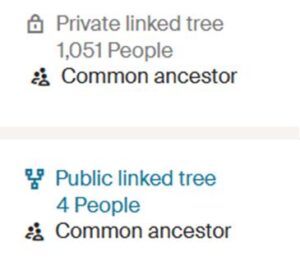
The majority of matches have online trees and even if these were private (but searchable) Ancestry can identify if you share a common ancestor. In several cases this is determined by the trees of other Ancestry users who are either not a DNA match or have not taken a DNA test. For this reason you need to be cautious, but checking the lines listed is usually relatively easy to do.
Once you have confirmed a relationship you can link your match to your own tree and a green symbol will appear on their image so you can easily identify them. You can also edit their relationship to you from the more general predicated relationship originally given.
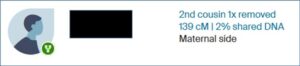
To help you work out how your matches are related to you there is also a colour coding system and a notes section which are very useful and can be seen at a glance in your match list. Read here for more details: https://support.ancestry.co.uk/s/article/Grouping-and-Filtering-AncestryDNA-Matches
Be aware though that any matches that you share less than 20cM (centimorgans) with will not appear on your shared matches. This level of match will probably be further than a 4th cousin distance but I have found documented 3rd cousin matches with much less shared cM, so it can be unhelpful that Ancestry filter these out in the shared match list (but not your actually match list). In fact very recently a client had a new 1st cousin twice removed match sharing 126cM. The client’s daughter however only shares 19.4cM (potential 5th cousin) with that same person. This is because DNA inheritance is not evenly distributed.
One issue to be aware of though it that viewing the trees of your DNA matches is only available if you sign up for a membership, which can be expensive. (Currently at least £120 for a year).
Another issue is that Ancestry will not allow DNA tests from any other company to be uploaded to their site.
MyHeritage:
This is the 3rd largest database with about 6.5 million testers but in my view the joint best with Ancestry in terms of usability.
As well as many of the positives points that it shares with Ancestry DNA in terms of uploaded trees, colour coding and notes sections, it also very helpfully will suggest how your shared matches are related to each other and not just to you. This means you can quickly see if your DNA matches are siblings, parent/child or cousins etc.
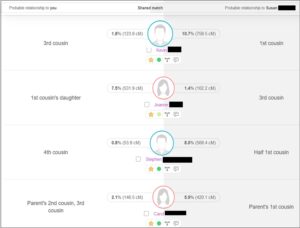
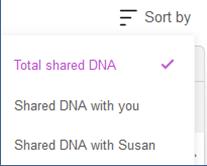
You can also sort shared matches based on their relationship to you or to your match.
Unfortunately this site does not show when your match was last active on the site and the number of responses I received was lower than those from Ancestry. In the same 12 month period I sent 107 messages, had 31 replies of which only 13 had any knowledge of their family history.
It is not always clear if you have previously sent that person a message either as the ‘contact’ button simply opens a new message box. You need to keep a note of who you have contacted and when.
Unlike AncestryDNA, the MyHeritage matches are not sorted into maternal or paternal groups and you also cannot edit the predicted relationship to the correct one.
Tests from different companies (including Ancestry) to be uploaded to this DNA site. This is a free service and you can contact your matches free of charge as well. You will need to pay a one off fee (currently $29 – approx. £23) to view your shared match list. https://education.myheritage.com/article/upload-dna-results-to-myheritage-why-its-worth-it/
23andMe
This site has the 2nd largest database, however this site is popular for DNA testing for medical reasons and many testers may have no interest in family history research but have not opted out of the DNA relatives part of the database.
Both my clients and I found it difficult to use. (Note: Due to a data breach users are currently not allowed to see shared match information which makes this site even harder to use).
This site does not show here amount of cM shared but uses a percentage and number of segments system. An example taken from one of my client’s records at 49.9% match for her daughters and between 0.85 and 0.51 are her known 3rd cousins once removed. It is not very accurate though as the 3rd cousin with a 0.63% match and sharing 3 segments appears to be at least a 5th cousin in reality.
This official 23andMe guide to relationships gives a very broad range which does not help you work out a true relationship.
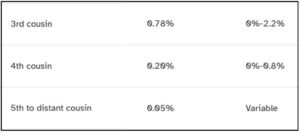
This site does not offer colour coding is available but there is a starred option and notes.
On a positive note It does allow you to include your family names and where your grandparents where born (which can be helpful) and create your family tree however most testers who match to my client have not done any of this.
Amongst its filters you can view which of your matches were the last active in the last day, week, month or over 6 months. As of this week 300 of one of my client’s matches had been online in the past week with almost 6, 000 matches not online for over a month or more.
All messages are listed in date order on the messages page, so in order to see the full conversation you must go to the individual profile page and click on the ‘message’ button.
The message response rate is much lower than either Ancestry or MyHeritage. Out of 82 messages sent in the last 12 months, only 18 replied and of those only 6 knew anything about their family history.
Like AncestryDNA, 23andMe does not allow DNA tests from any other company so you must test directly with them.
Conclusion:
If you are thinking about taking a DNA test I would suggest you take an AncestryDNA test for the reasons given above and download your test results and upload them to other sites especially MyHeritage.
Important note:
I do not have any links to any DNA testing company other than being a user, nor am I being paid for my thoughts. The above is strictly my own opinion based on my experiences.
Read my other DNA posts here: