Understanding relationships in family history trees is not always easy, and when dealing with DNA matches can add to the confusion. This is a simple guide to work out which set of grandparents you share with your DNA matches, without the confusion.
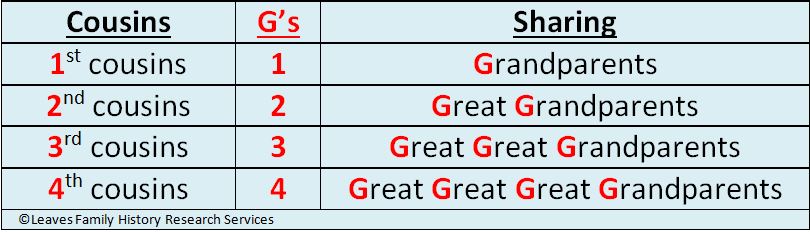
What does it mean when a DNA match is your potential 2nd or 3rd cousin? Ordinary (1st cousins) share the same grandparents so 2nd and 3rd cousins etc. are a generation further back. You don’t have to sit with a family tree to work it out though; this simple trick will help you.
All you need to do is ‘Count the G’s’. The word ‘Grandparents’ has one G (1st cousin), Great Grandparents has 2 G’s (2nd cousin). It is a simple as that.
Remember the potential relationship of DNA matches is dependent on how much and which part of the DNA is inherited. Children have 50% DNA from each of their parents, but siblings may not have exactly the same DNA as each other. It all depends on which strands of DNA they have inherited. Likewise, grandchildren do not necessary inherit exactly the same 25% from each grandparent. You can read more about that here: How much DNA do you share grandparents?
Learn more about relationships and DNA in my other posts: